Rumi and the order
Rumi and the Mevlevi order
Who Rumi was, how the Mevlevi order began in Konya, why Istanbul has Mevlevi lodges, and what happened to them after 1925.
Reserve the dervish evening ↗Quick answer
Rumi was a 13th-century Sufi poet who settled in Konya and died there in 1273. His son Sultan Veled and his follower Husameddin Chelebi founded the Mevlevi order after his death. The order spread across the Ottoman Empire, including Istanbul, until the lodges were closed in 1925. UNESCO lists its sema ceremony.
Rumi
Rumi, whose full name was Jalal al-Din Muhammad, was born in 1207 and died on 17 December 1273. His family came from Balkh, and the Mongol advance pushed them west. He settled in Konya, then the capital of the Seljuk Sultanate of Rum, which is where the name Rumi comes from. He was expected to follow his father as a religious scholar and teacher. His Masnavi is regarded as one of the great poems of the Persian language, and his poetry is now read across the world in many translations.
Shams and the poems
In 1244, Rumi met the wandering dervish Shams of Tabriz, and the meeting changed his life. Shams disappeared in 1248, and Rumi's grief became an outpouring of lyric poems in the Divan of Shams of Tabriz. Biographies of Rumi mix history with legend, so scholars treat the old accounts with care. A popular story says he first began to turn when he heard goldsmiths hammering in the Konya bazaar. Another view holds that he learned whirling from Shams. Both stories are told about the origin of the sema.
The order begins in Konya
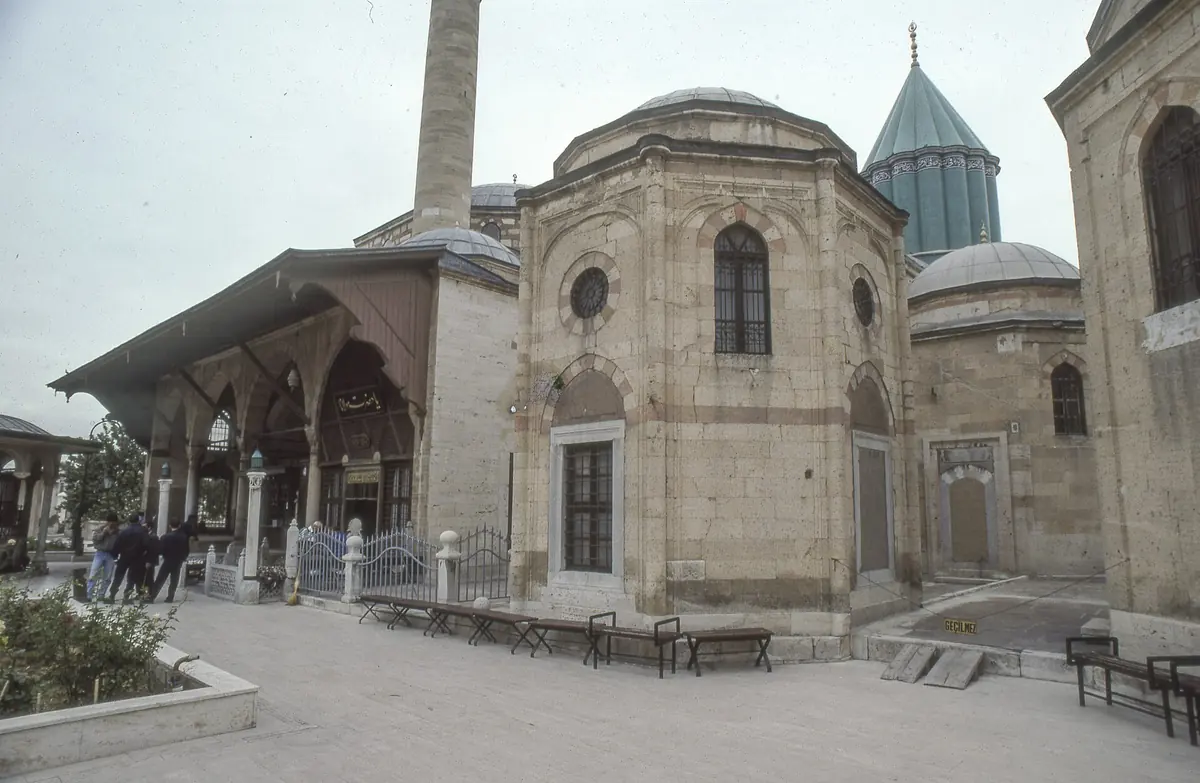
After Rumi's death, his son Sultan Veled and Husameddin Chelebi established the Mevlevi order, and they had a mausoleum built in Konya over his grave. The tomb chamber was completed in 1274 under a dome covered with turquoise tiles, which is the landmark of the city today. The order took its name from Mevlana, the title Turks use for Rumi, meaning our master. Its leader is traditionally a Çelebi, a descendant of Rumi's family.
Lodges across the empire
Under the Ottomans the order spread across the empire, and Mevlevi lodges, called mevlevihane, were built in many cities. The Galata Mevlevi Lodge in Istanbul, founded in 1491 during the reign of Bayezid II, is described as the oldest Mevlevi lodge in the city. It has an octagonal ceremony hall with 18th-century Baroque elements. Later sultans supported the order, and Sultan Selim III read the Masnavi and played the ney, and his reign is often called the golden age of the order.
Read next: Whirling dervish sema explained
Training and a way of life
UNESCO notes that dancers once received 1,001 days of secluded training in the lodges, learning ethics, codes of behaviour and beliefs through prayer, religious music, poetry and dance. After this training they remained members of the order but returned to their work and families. Alongside the sema, the order's practices include study of the Quran and Rumi's works, meditation and conversation led by the sheikh. The whirling is one part of a larger discipline, which a good introduction at a performance should make clear.
1925 and after
In 1925 Turkey's new republic closed the Sufi lodges, and the Konya lodge became the Mevlâna Museum, which opened in 1927. UNESCO records that all mevlevihane were closed in that year. The state began to permit public performances again in the 1950s, and eased restrictions in the 1990s. In the decades of closure the tradition survived, but largely as music rather than religious teaching. Today sema ceremonies in Turkey are often presented as cultural events, and some groups work to restore the original intimate character.
Şeb-i Arûs
The most important annual sema is the commemoration of Rumi's death, called Şeb-i Arûs, meaning nuptial night or night of union. The order sees his death as a wedding with God. The commemoration runs for several days in Konya in December, and the final night falls on the anniversary of his death, 17 December. Pilgrims travel from many countries, and the event has a ticketing system for the ceremony. You will not see that in an Istanbul evening, but it explains why the order treats December as its centre of gravity.
Frequently asked questions
When did Rumi live?
Rumi lived from 1207 to 1273. He died in Konya on 17 December 1273 and is buried there.
Who founded the Mevlevi order?
His son Sultan Veled and Husameddin Chelebi founded it after Rumi's death in 1273, in Konya.
Why were the dervish lodges closed?
Turkey's secular republic closed Sufi lodges in 1925. Public ceremonies returned in the 1950s.
What is the oldest Mevlevi lodge in Istanbul?
The Galata Mevlevi Lodge, founded in 1491. It is now a museum that also hosts ceremonies.
What is Şeb-i Arûs?
The annual commemoration of Rumi's death in Konya each December, with a final night on 17 December.
Sources